New to AI? Start here → Start 1. ChatGPT vs. Codex: what's the difference?
Five ingredients of a good prompt
In one line
Five ingredients of a prompt that gets you the answer you want
Not the skill of writing long prompts, but the habit of filling in missing details.
The big picture
Illustration (may look a little different from the real screen)
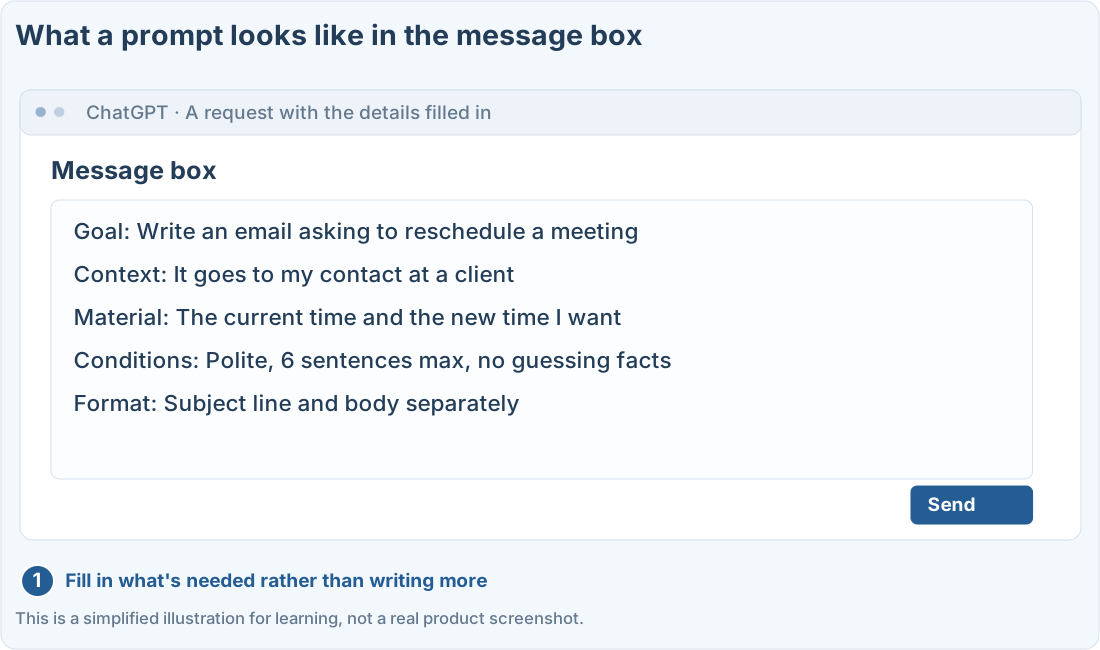
Follow along
Goal, context, material, conditions, format
A prompt is the request you give the AI. You don’t need to fill in a long form every time, but if the answer is off, check whether one of these is missing.
- Goal: What do you want to make or find out?
- Context: Who will use the result, and where?
- Material: What should it base the answer on?
- Conditions: Length, tone, budget, limits?
- Format: A table, a list, an email? What shape do you need?
Turn “write an email” into this
★ Compare them ★
First request
Write an email to a client.
With conditions added
Write an email asking a client to reschedule a meeting. Keep it polite, 6 sentences or fewer. Leave the reason and the new time in square brackets.
If you don’t know a name or date, have it leave a blank. Making sure it doesn’t fill gaps with believable fake details is part of a good request.
Illustration (may look a little different from the real screen)
Email asking to reschedule a meeting. Polite, 6 sentences max. Leave anything unconfirmed blank.
Sample replySubject: Request to reschedule our meeting
Hi [Name],
Due to [reason], I'd like to ask if we could reschedule our meeting.
Would [new time] work for you?
Email asking to reschedule a meeting. Polite, 6 sentences max. Leave anything unconfirmed blank.
Sample replySubject: Request to reschedule our meeting
Hi [Name],
Due to [reason], I'd like to ask if we could reschedule our meeting.
Would [new time] work for you?
If you have an example in mind, add a short one
“Friendly” means different things to different people. Give one sentence you like as an example, and say which qualities it should follow.
“Write it in a short, gentle tone like the example below. Don’t copy the sentences. Just use the tone as a reference.”
Prompts you can copy
Change the parts in square brackets to fit your situation, then paste it into ChatGPT or Codex.
Ask with all five ingredients
Improve an answer you already got
Where people get stuck
Even a good prompt doesn’t guarantee accuracy
Precise conditions help shape the result, but they can’t fully get rid of factual mistakes. Check sources for the latest prices, policies, and numbers, and add conditions after you see the first answer.
In real work, telling it the actual audience, material, and how you’ll judge the result is more useful than adding “Act like an expert.”
Quick check: If I write a precise prompt, can I skip fact-checking?
Answer: “No, check important facts separately”
A good prompt helps improve results but doesn’t guarantee they’re correct. You still need to check important facts and sources.
Official sources
I'm stuck here
Stuck while following along? Tell me where. Only the site owner sees this. Leave your email only if you'd like a reply.
💌 Get new tips by email
I'll email you when a new tip goes up. No ads, ever.